 Careers
 Poslovi
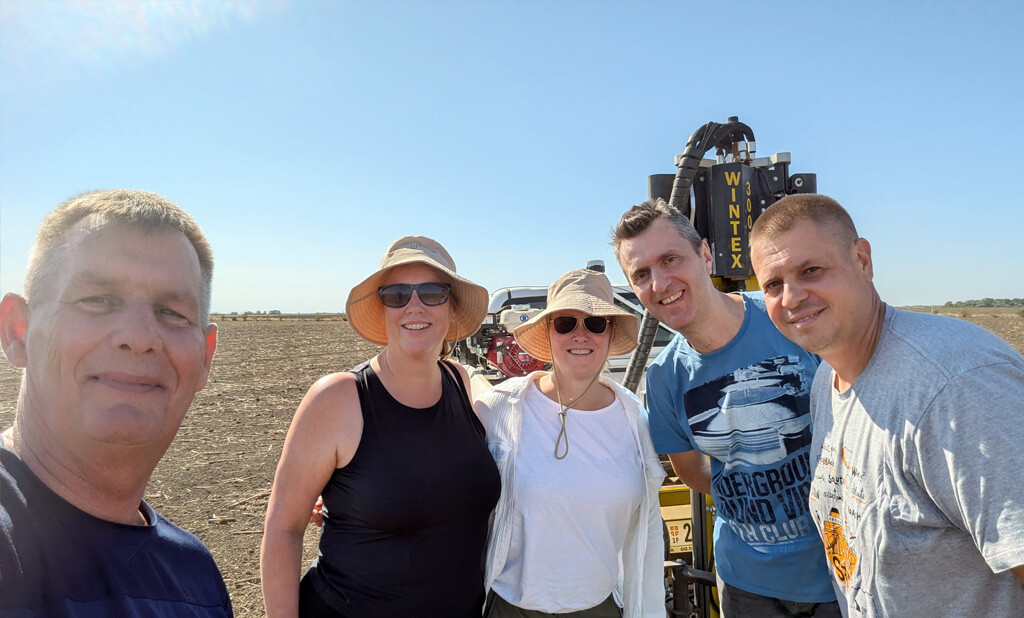
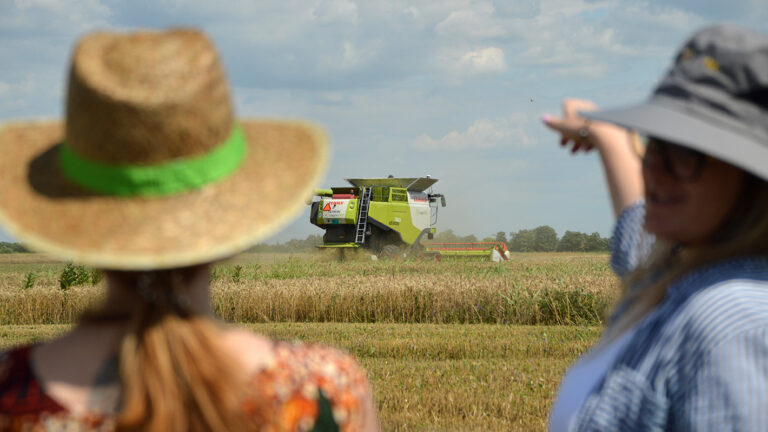
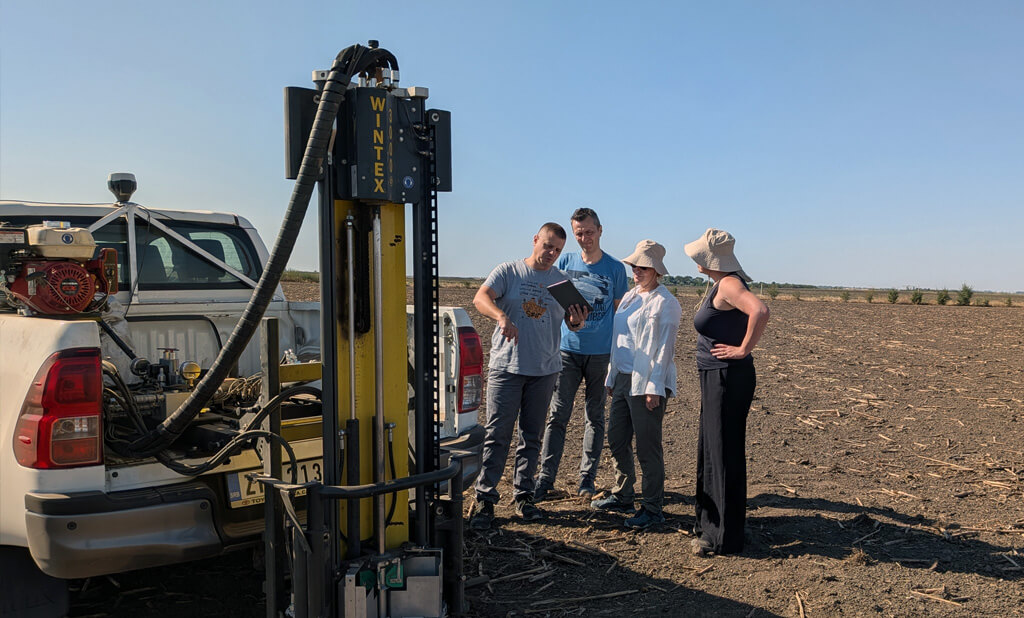
On 2 and 3 September, Prof. Rachel Creamer and Assoc. Prof. Titia Mulder joined the LoginEKO agronomy team in the fields at Mužlja, Sanad Breg and Novi Kneževac to critically review our Soil Health Monitoring Strategy before its implementation.
Most reviews of a monitoring plan happen in a meeting room, with the methodology presented on a screen. This one happened around open soil profiles, with spades in hand and repeated discussion of a deceptively simple question: what can a single soil sample actually tell us about a field, a group of fields, or an entire farm?
The visit resulted in several important recommendations that will now be incorporated into the revised version of our monitoring strategy.
A stronger basis for representative sampling
Two concepts came up repeatedly throughout the discussions: spatial variability and statistical confidence.
Across 3.278 hectares of farmland, soil conditions vary substantially: between locations, between fields and within individual fields. A monitoring system therefore needs to do more than measure soil properties. It must also define how confidently an observed value, or an observed change over time, can be extrapolated beyond the individual sampling point.
One of the main recommendations from the review was therefore to substantially increase the intensity of detailed sampling. The preliminary assessment is that approximately three times as many sampling points may be required compared with our current plan.
More importantly, the final number should not simply be fixed in advance. Sampling intensity should be determined by the variability observed in the soil and by the level of precision required for the conclusions we want to make.
This changes the question from “How many samples should we take?” to a more meaningful one: “How much sampling is needed to detect real change and draw reliable, scientifically defensible conclusions about how our management is influencing the soil?”
A second major recommendation concerns the way representative monitoring locations are selected.
Our original strategy was to identify medoid zones: representative areas within fields selected from groups of locations with similar soil and production characteristics. Following the field review, Rachel and Titia recommended moving one level higher and defining medoid fields instead.
A medoid field would be an actual field that best represents a wider group of fields with comparable soil and production characteristics. Additional candidate fields from the same cluster would then serve as validation fields.
This would allow us to test a critical assumption in long-term monitoring: whether changes measured in a representative field can reasonably be interpreted as changes occurring across the wider group it represents.
The proposed monitoring structure is therefore hierarchical, moving from the broader landscape level to representative fields, while the sampling design explicitly accounts for within-field spatial variability.
What the soil profiles revealed
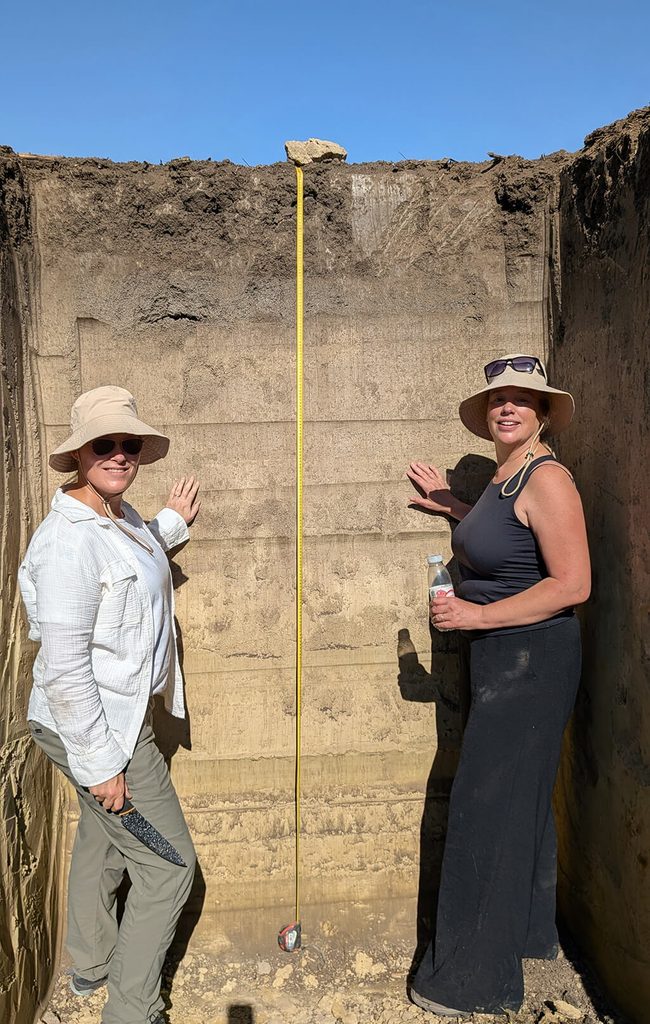
The open soil profiles also demonstrated why this hierarchy matters.
We already knew from years of farming experience that soils at our northern locations behave differently from those around Mužlja and Aradac further south, particularly in terms of their water and air regime. What became much clearer during the profile assessment was that these differences are also expressed in soil structure itself, an important physical component of soil health.
The heavy clay profile at Mužlja showed predominantly prismatic structure, while the profile at Novi Kneževac was characterised by a more blocky structure. These observations will change the way we describe and interpret the two soil environments in future monitoring.
The contrast became even stronger when the heavy clay soils were compared with the lighter, sandy and erosion-prone soils at Sanad Breg.
This raised another fundamental methodological question: can the same soil-health indicators be interpreted in exactly the same way across such different environments?
The answer may not always be yes. Some indicators can be measured consistently across soil types, while their reference values, thresholds, or interpretation may need to reflect the specific soil environment. That distinction will be important as the monitoring strategy develops.
From soil diagnosis to field management
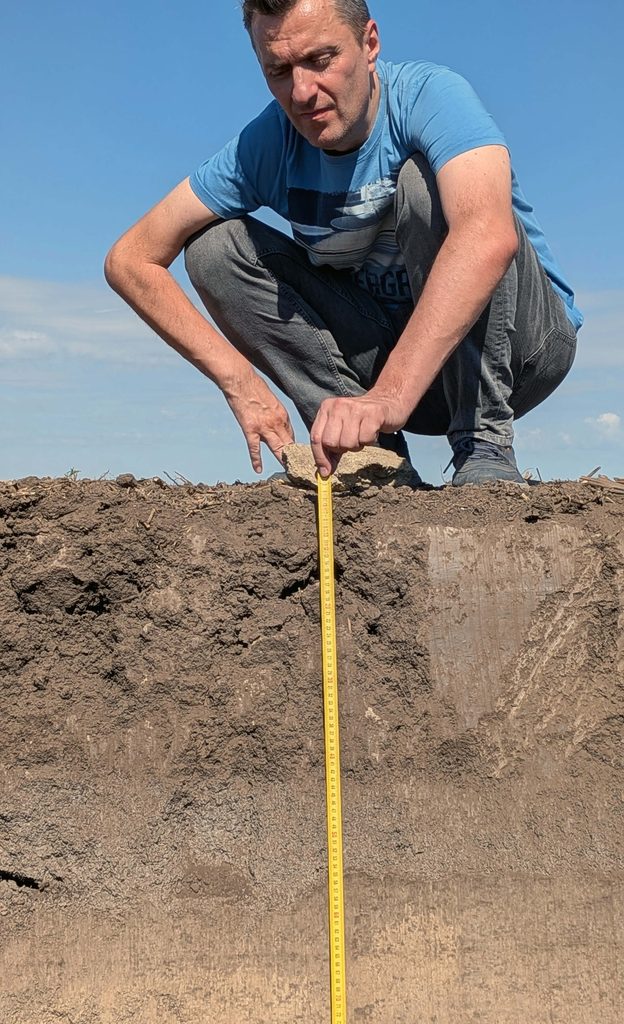
The profiles were not only useful for designing the monitoring system. They also produced immediate agronomic consequences.
The most important example came from Sanad Breg. At approximately 40–45 cm depth, one profile contained a carbonate-rich layer roughly 20 cm thick.
Under dry conditions such as those experienced in 2026, this layer likely constrains root development. The field assessment indicated that mechanically disturbing the layer would not remove the underlying limitation and could aggravate the problem. For this field, subsoiling was therefore ruled out.
The broader lesson is that decisions on deep tillage cannot be made uniformly across the farm.
Even where subsoiling is agronomically justified, soil moisture at the time of the operation is critical. The soil needs to be dry enough to fracture rather than deform or smear. On our high-clay soils, that operational window can be surprisingly narrow.
Ploughing depth requires the same field-specific approach. The thickness of the topsoil horizon varies between fields and may also vary within a single field. Working depth should therefore relate to the actual soil profile rather than be determined only by machinery settings or habit.
In practical terms, sometimes the most useful decision-support tool is still a spade in the field.
Strengthening the laboratory diagnosis
The review also led to changes in the laboratory component of the strategy.
In addition to cation exchange capacity, we plan to determine the major exchangeable cations separately: calcium, magnesium, potassium and sodium.
This will provide a more complete picture of the exchange complex, allow a more robust assessment of base saturation, and help us investigate whether elevated exchangeable sodium contributes to the pale and structurally problematic patches observed in some fields.
Simple field tests can support this diagnosis. For example, an aggregate-dispersion test using water and gypsum can provide a rapid qualitative indication of structural instability.
However, the field test is a screening tool rather than a substitute for laboratory analysis. The diagnosis of possible sodicity will ultimately depend on the measured soil properties.
What happens next
We are now revising the LoginEKO Soil Health Monitoring Strategy to incorporate the recommendations from the visit.
The revised version will include a stronger statistical basis for determining sampling intensity, a shift from the originally planned medoid-zone concept towards representative medoid fields supported by validation fields, and a clearer hierarchical structure for interpreting variability from the broader landscape level to individual fields. Within-field spatial variability will remain an explicit part of the sampling design.
The laboratory programme will also be expanded where additional measurements are needed to explain the processes observed in the field.
Once revised, the strategy will go back to Rachel Creamer and Titia Mulder for further scientific review and discussion. At the same time, the field-specific agronomic recommendations identified during the visit will be incorporated into the management plans for the relevant fields.
LoginEKO joined Wageningen University & Research’s Global Network of Lighthouse Farms in October 2023. This visit showed why that collaboration matters: not because an external review simply confirms what we already do, but because good scientific discussion should expose assumptions, challenge methodology and, where the evidence requires it, change the plan.